Some skin findings are promising (but the evidence does not support every claim about hair growth), scar repair, or injections. No peer-reviewed studies have linked GHK-Cu to liver toxicity at standard doses — and the peptide does not appear to be hormonally active. The human evidence is still in early stages, and there are no established protocols supported by peer-reviewed trials.
It is important for patients to be informed by clinicians regarding the difference between claims of medical treatment and benefits related to cosmetic KLOW peptide US ordering information appearance. Numerous claims of additional benefits, particularly those concerning hair regrowth and systemic regeneration, are based more on laboratory research and small-scale studies than on extensive human trials. Researchers have investigated the connection between it and components of the extracellular matrix, as well as its antioxidant capacity and the genes pertinent to tissue repair. The characterization of GHK-Cu’s proposed mechanisms is still underway — and they ought to be presented with suitable caution.
That story took me to two individuals who had experimented with low‑dose topical and subcutaneous GHK‑Cu for months. Drug combinations often enhance therapeutic effect or cut needed dose, and similar strategies might reduce side effects in reproductive treatments. In wound and tissue repair scenarios, GHK upregulates antioxidant enzymes and downregulates inflammation, all of which can assist recovery post operation or trauma to reproductive organs. Log dose (length), and what other supplements or medications you are taking, so you can pinpoint interactions. Examples from related peptide use indicate cautious low-dose trials under supervision — not routine high-dose supplementation. Systemic supplementation typically begins with low doses and the minimum effective amount.
You can retain interest in a promising use while leaving broader claims unanswered. The topical studies above do not resolve that injectable risk. FDA warns that compounded injectable GHK-Cu may pose immunogenicity risks related to aggregation and peptide impurities. Our guide to laboratory, animal, and human evidence explains those distinctions.
No data has been published regarding the biologically active half-life of GHK-Cu in its intact form following injection in humans. The peptide exhibits true biological activity, yet there is a significant difference between that activity and the verified clinical results from human injections. At clinical doses, the risk of copper toxicity has not been documented.
Abdulghani et al. demonstrated that facial cream containing GHK-Cu applied for 12 weeks increased collagen production in the majority of treated skin sites compared to placebo . In vitro studies show GHK-Cu increases collagen synthesis in human dermal fibroblasts. Specifically, it activated genes involved in tissue repair, stem cell activity, and antioxidant defense while suppressing genes linked to inflammation, fibrosis, and tissue destruction . Researchers found that GHK modulates the activity of 4,048 human genes — roughly 6% of the human genome . GHK-Cu stimulates fibroblasts to produce more collagen , types I and III,, elastin, and glycosaminoglycans like decorin and dermatan sulfate . Subsequent research through the 1980s and 1990s established its wound healing properties.
Cellular Pathways
GHK-Cu has obvious connections to tissue repair — inflammation modulation, and cell signaling relevant to reproductive health. Start with a low, well‑documented dose and maintain consistent use for at least eight weeks before judging. Exercise level matters; those who train intensely sometimes attribute faster recovery to GHK‑Cu — while sedentary users report less change. Others changed dose or switched to saline vehicle to mitigate irritation.
In GHK-Cu research, what endpoints have been measured and what is the statistical significance?
GHK-Cu dosage guide with injection protocols by goal (skin, hair, healing), reconstitution steps, dosage charts, side effects, and before/after timeline. The 8 benefits documented here span skin rejuvenation, wound healing, hair growth, inflammation control, antioxidant defense, 4,000+ gene modulation, cognitive support, and bone repair. Topical GHK-Cu has a strong safety record across multiple human trials lasting up to 12 weeks with no significant adverse events. Plasma GHK-Cu drops from roughly 200 ng/mL at age 20 to 80 ng/mL by age 60, a 60% reduction. Topical delivery (0.01-1% concentration) is backed by human skin trials and works for fine lines, collagen, and surface wound healing. For whole-body anti-aging protocols, GHK-Cu combined with one of the healing peptides covers the broadest range of mechanisms.

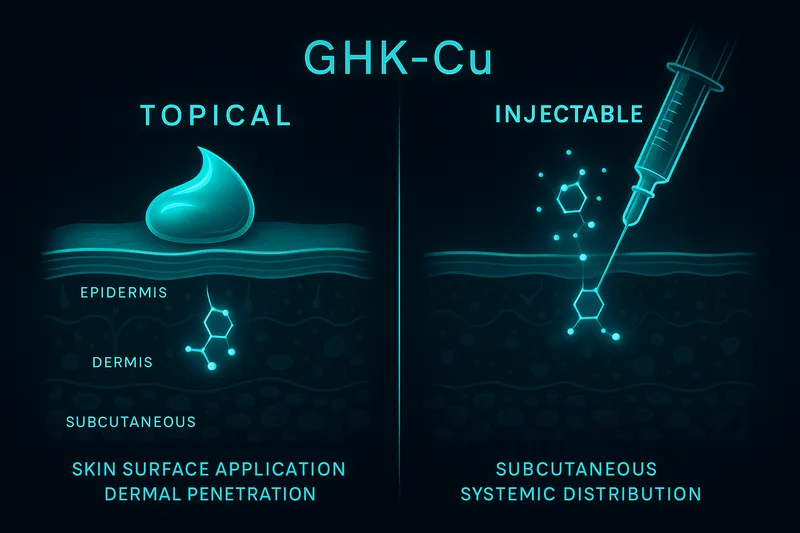
Topical, Compounded, and Injectable GHK-Cu
It has been under research for over 50 years, with consistent findings of excellent tolerability in both topical and injectable applications. GHK-Cu is dosed individually as part of a custom protocol. GHK-Cu is available in multiple delivery formats (each with different bioavailability profiles), appropriate use cases, and levels of clinical oversight required. This mechanism underpins many of its diverse regenerative effects. GHK-Cu reduces levels of pro-inflammatory cytokines — including IL-6 and TNF-alpha. These findings provide a strong biological rationale for its use in aesthetic procedures and post-treatment recovery.
What are the risks of GHK-Cu injections and what monitoring makes sense?
GHK-Cu has more than 40 years of cosmetic use and 100+ peer-reviewed studies with no serious adverse events documented at standard doses. Injectable has only animal and lab evidence for systemic tissue repair and wound healing; no human injection trial exists. Levels decline roughly 60% between age 20 and 60 — which tracks with visible aging.
Realistic timelines for topical and injection results (how to measure progress), clinical trial findings, and honest expectations. In human blood, GHK-Cu concentration declines sharply with age, from roughly 200 ng/mL at age 20 to about 80 ng/mL at age 60 — which is the biological rationale for supplementing it topically or by injection to support tissue repair and skin health in older adults. It notably stimulates fibroblasts to increase collagen (elastin), and glycosaminoglycan synthesis—including hyaluronic acid—strengthening skin elasticity and hydration source.

Also — apoptosis is the mechanism through which many anti-cancer treatments, including melanoma treatments, work. They compared a serum described as 2% GHK-Cu on one eyebrow with its inactive base (or vehicle), on the other. A 2026 randomized, double-blind study compared a serum described as 2% GHK-Cu with its inactive base on opposite eyebrows in 18 adults aged 18 to 40.